
Vera Schwarcz
Summer 2026
“While in Paris, I savored again the beautiful medieval tapestries known as “La Dame a la Licorne” — dedicated partially to the five senses. I could stay for hours in the darkened room of Musee de Cluny. A few years ago I did, and a long poem came.”
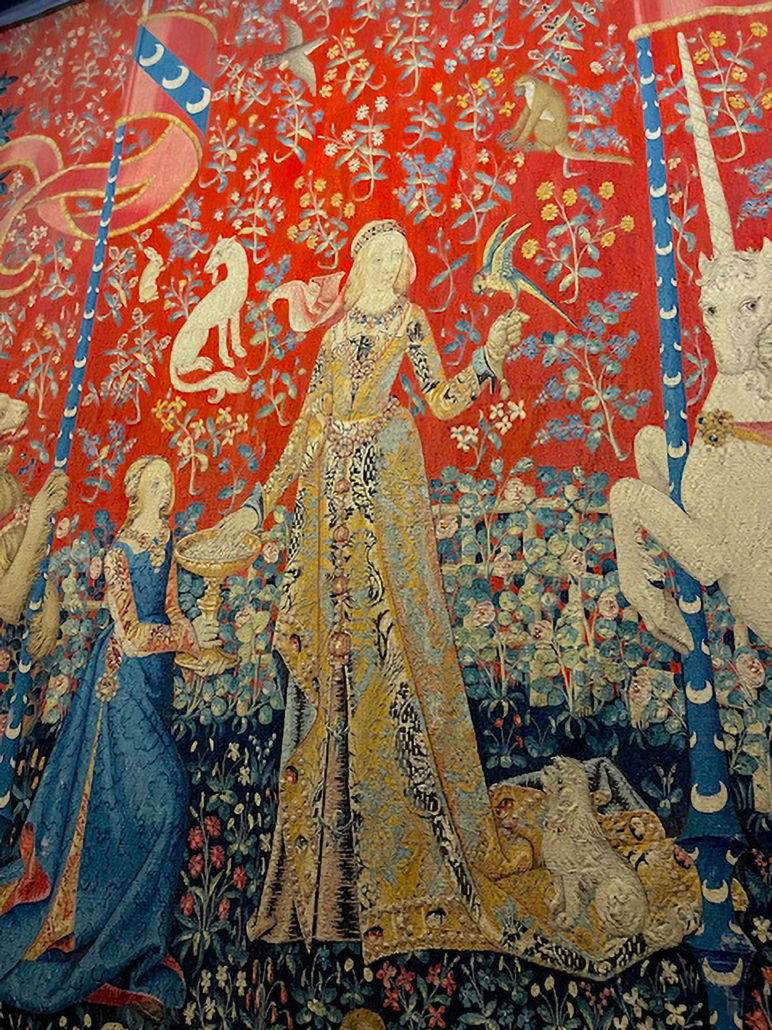
La Dame a Licorne
I am but silk and wool. I embroider time. Life is short. Art is well armed for lasting. If you look at me long, you will get news of an undiscovered country, news from a lady inspired by beasts. My wool warms sinews of dreams. Never a lace-maker, I thread filigrees of light out of the dross of touch, smell, sound, the queen of periwinkle, daisies, trillium and wart invites you to sojourn among fading colors, revive your sight. Touch — The Chained Monkey At first it looks like glittering gold, crown and belt all jewels, until you see it is but common currency, links of metal tie her down, loops around her neck, all locked, her waist girded by coins, slender hips frozen in a sea of blue velvet. The unicorn, like an obedient dog, stands still, horn resting in her hand. Above this couple, two monkeys chained from rib to neck, bondage writ large on stiff royal standard. La Dame, like us, imprisoned. She dreams only what she can touch. Scent — A Basket of Flesh Five scurrying rabbits in a field of lavender, sage, thyme, no chained monkeys anywhere in sight. La Dame, herself, a lithe willow, arms delicately lifted as she weaves a crown of forget-me-nots, her aqua of her robe is open, a resplendent waterfall of chestnut leaves, orange acorn blossoms guard her as faithfully as lion and unicorn, ready to serve (not servile) while foxes, cranes are free to graze acres of spurge, columbine, watercress and sorrel. You, too, are free to feast on fleshy blossoms in her wicker basket. The unicorn eats nothing but roses. Sound — The Turkish Carpet A self-contained geometry reigns here: La Dame ringed by pure sound, unicorn at peace, the lion crouches, imperial standard flowering between well balanced thighs, two foxes listen amidst meadow rue, alert to the parallelograms in the Turkish carpet, a silent harp. The lady’s fingers pluck chords of silence. An artist can be wrong, her threads entangled in noise. Not here. Each note, each word corporeal, capacious. There is always a dog in the corner of the tapestry. This time, he never ceases to smile. Passing years cast pallor on wool and silk: rose of lips becomes mere alabaster, red of roses, dull wine, night of robes, memory of onyx, fading. A poetess will come someday to grant La Dame a second life, she will know how to sew silk to stone, how to weave shadows more luminous than light.
Vera Schwarcz is a distinguished scholar, writer, and poet best known for her work on modern Chinese intellectual history, cultural memory, and the relationship between Chinese and Jewish historical experience.
She was born in Romania in 1947 and emigrated to the United States as a teenager after surviving the aftermath of World War II in Eastern Europe. Much of her later work reflected the influence of being the daughter of Holocaust survivors.
For decades Vera taught at Wesleyan University in Connecticut, where she became the Freeman Professor of East Asian Studies and directed the Freeman Center for East Asian Studies. Her specialty is modern Chinese history — especially with regard to Chinese intellectuals, memory, trauma, and truth-telling after political catastrophes. She was among the very first American scholars allowed to study in China after U.S.-China diplomatic relations reopened in 1979, spending time at Peking University. She compares how societies remember trauma and preserve identity across centuries. Vera is also a multilingual poet who has written extensively about such topics as exile, remembrance, aging and moral responsibility.
A note from Cora:
Vera and I have a close friendship that began when she came to work on her poetry at the writer’s retreat I owned in the Catskill Mountains. Our friendship continued through the years even after she moved to Jerusalem. Vera has been my inspiration. She never fails to stress the meaning of hope to all of us through her messages and photography. She has the strength and faith to continually send breath-taking, beautiful photos of her surroundings even while living where she does. Vera never lets us forget to see the beauty around us regardless of where we live. If you want to see more of her work, or receive a list of her award-winning books, email us at coraschwartz@gmail.com.

